
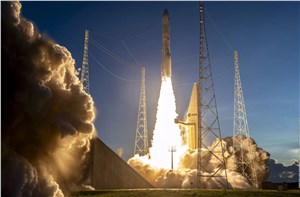
KOUROU, French Guiana – In a flawless evening launch, Arianespace’s Ariane 6 rocket has successfully delivered the Copernicus Sentinel-1D satellite to orbit, marking a significant milestone for Europe’s renewed launch capability and its flagship environmental monitoring program.
The heavy-lift launcher lifted off from Europe’s Spaceport in French Guiana on November 4, 2025, at 6:02 p.m. local time. Approximately 34 minutes into the flight, the Sentinel-1D satellite was successfully deployed into a Sun-synchronous orbit at an altitude of 693 km.
This mission represents the fourth consecutive successful flight for the new Ariane 6 and its third commercial launch, solidifying the vehicle’s operational status. For the mission, the rocket flew in its Ariane 62 configuration, equipped with two solid-fuel boosters and a short fairing.
David Cavaillolès, CEO of Arianespace, hailed the achievement. “Tonight, Arianespace has successfully launched the EU’s Copernicus Sentinel-1D satellite, on board Ariane 6,” he stated. “With this mission, we have now delivered seven Sentinel satellites for the emblematic Copernicus program, underscoring our commitment to using space for the benefit of life on Earth.”
The success was also echoed by Martin Sion, CEO of prime contractor ArianeGroup, who emphasized the launcher’s proven reliability and the ongoing production ramp-up, which is “guaranteeing Europe’s sovereign access to space.”
The Sentinel-1D satellite, built by Thales Alenia Space, is a critical component of the European Union’s Copernicus program. As the world’s most advanced Earth observation system, Copernicus provides continuous and free data on the planet’s environment.
Sentinel-1D is equipped with advanced radar technology, allowing it to capture imagery of Earth’s surface regardless of cloud cover or time of day. This data is vital for a wide range of applications, including monitoring the extent of sea ice, tracking the movement of icebergs and glaciers, observing ground subsidence, and detecting marine pollution like oil spills. The satellite’s deployment ensures the continuity of this essential service for users worldwide.
