
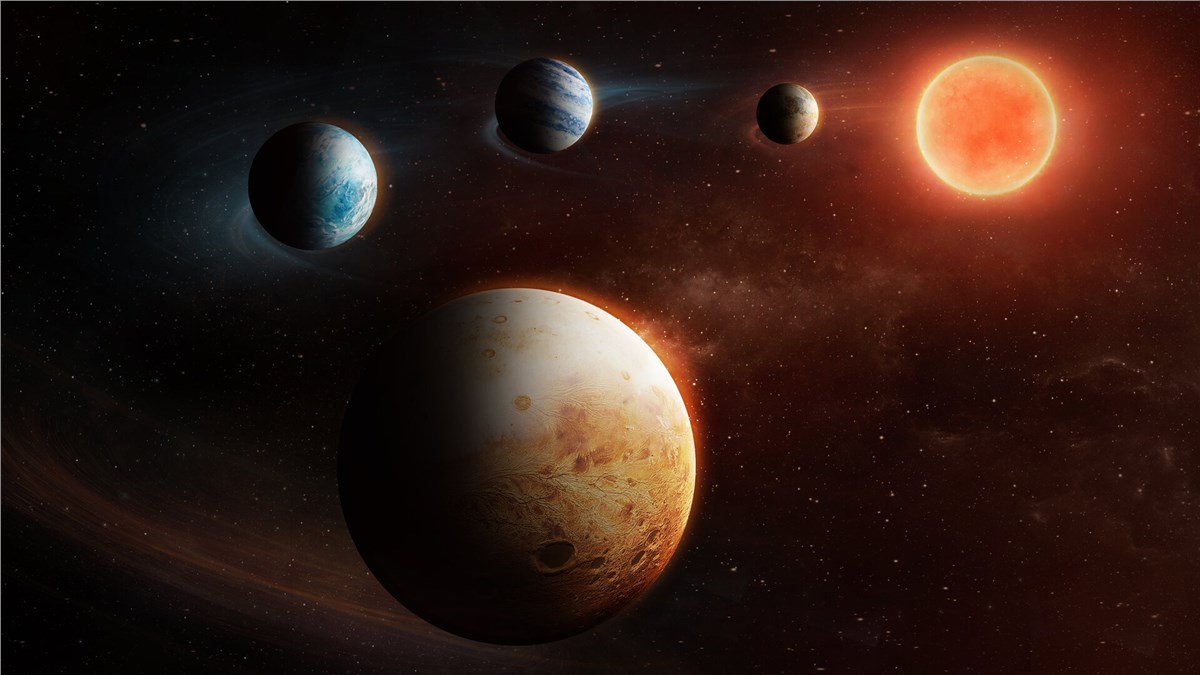
The European Space Agency’s Cheops satellite has discovered a planetary system that defies the basic rules of how planets are supposed to form. Around the star LHS 1903, scientists found four planets arranged in a pattern that shouldn’t exist: rocky, then gaseous, then gaseous, and finally rocky again at the far edge of the system.
This breaks the fundamental rule observed across the universe. Planets close to their star are typically small and rocky because stellar radiation blasts away lighter gases. Further out, where temperatures drop, planets can accumulate thick atmospheres and become gaseous giants. Our own Solar System follows this pattern perfectly: four rocky inner planets and four gaseous outer ones.
The system around LHS 1903 starts normally. The innermost planet is rocky, followed by two gaseous worlds. But Cheops data revealed a small fourth planet lurking in the cold outer reaches that appears to be rocky. It has no business being there.
“We call it an inside-out system,” said Thomas Wilson from the University of Warwick, who led the research team. “Rocky planets don’t usually form so far from their star.”
The discovery sent scientists searching for explanations. Could a massive collision have stripped away an atmosphere? Did the planets swap places over time? Computer simulations ruled out both scenarios.
Instead, the evidence points to something stranger: these planets may have been born one after another, not all at once. The star might have given birth to its worlds sequentially over millions of years. By the time the outermost rocky planet formed, the system had likely run out of gas—the essential ingredient for building planets. It formed in what researchers call a “gas-depleted environment,” something theory says shouldn’t work.
“This small rocky world is defying expectations,” Wilson said.
The discovery challenges planet formation theories built almost entirely on observations of our own Solar System. For decades, scientists assumed the pattern we see at home was universal. As telescopes like Cheops reveal more strange exoplanet systems, that assumption crumbles.
ESA project scientist Maximilian Günther sees this as mission accomplished. “Finding clues like this for solving the puzzle of planet formation is exactly what Cheops set out to do.”
The system around LHS 1903 may be an odd outlier or the first hint of a trend we haven’t recognized. Either way, it forces astronomers to reconsider what they thought they knew. Perhaps our neatly ordered Solar System, with its tidy pattern of rocky then gaseous planets, is the exception rather than the rule.
