
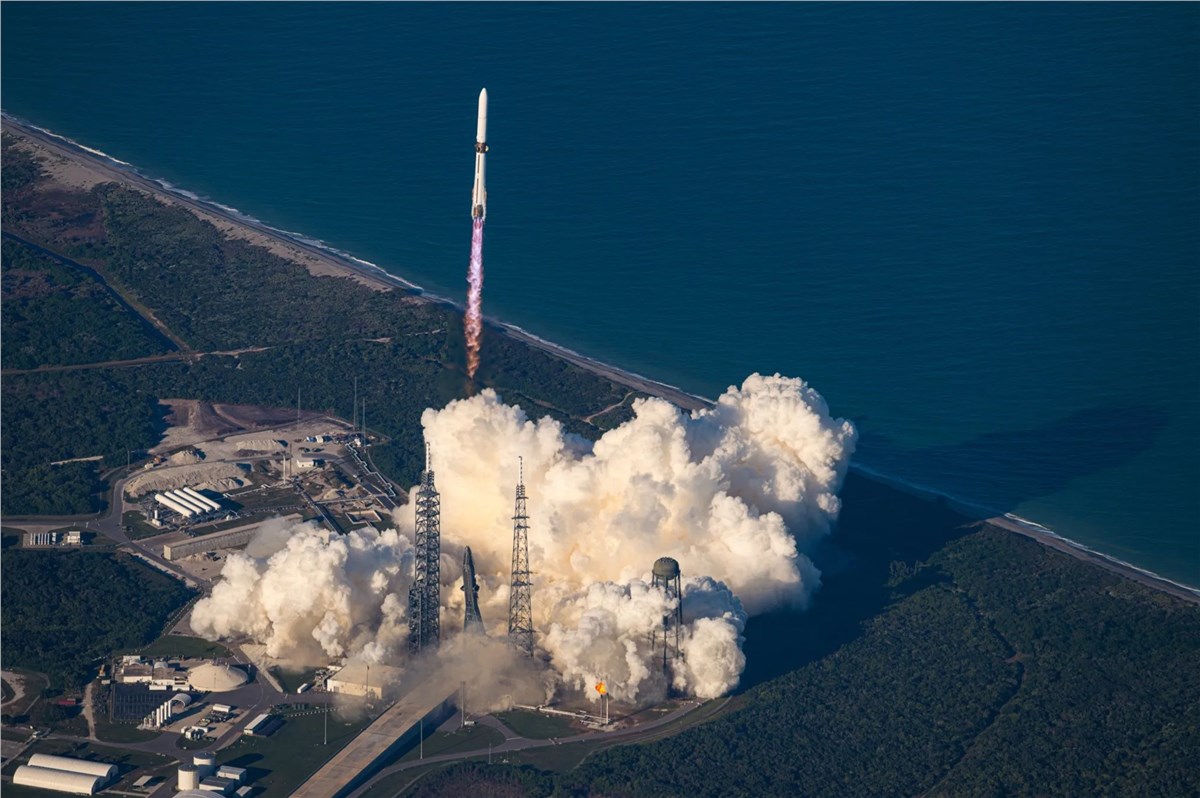
NASA has launched a pair of spacecraft, the twin ESCAPADE probes, on a pioneering heliophysics mission to Mars. The successful launch aboard a Blue Origin New Glenn rocket from Cape Canaveral marks a significant step in studying the Red Planet’s interaction with the Sun. This mission is crucial for preparing for future human exploration of Mars by understanding the planet’s harsh space weather.
The primary scientific goal of ESCAPADE is to investigate how the solar wind, a relentless million-mile-per-hour stream of charged particles from the Sun, has eroded the Martian atmosphere over time. This process is believed to have transformed Mars from a warmer, wetter world into the cold desert planet we see today. By analyzing this atmospheric stripping, scientists hope to reveal the history of Mars’s climate and its surface water.
Led by the University of California, Berkeley, and built by Rocket Lab, the two spacecraft will map Mars’s unique magnetic environment and its dynamics. Following the launch, ground controllers successfully established communication with both probes. The mission represents a key part of NASA’s broader strategy to understand Mars’s past and present, ensuring the safety of future robotic systems and astronauts.
The launch also served as a valuable test for the New Glenn rocket, providing critical data for NASA’s Artemis program and its long-term vision for human deep space exploration. Additionally, the rocket carried a technology demonstration from Viasat, funded by NASA’s Communications Services Project, which successfully tested new space communications capabilities using a geostationary satellite network to relay launch telemetry.
