
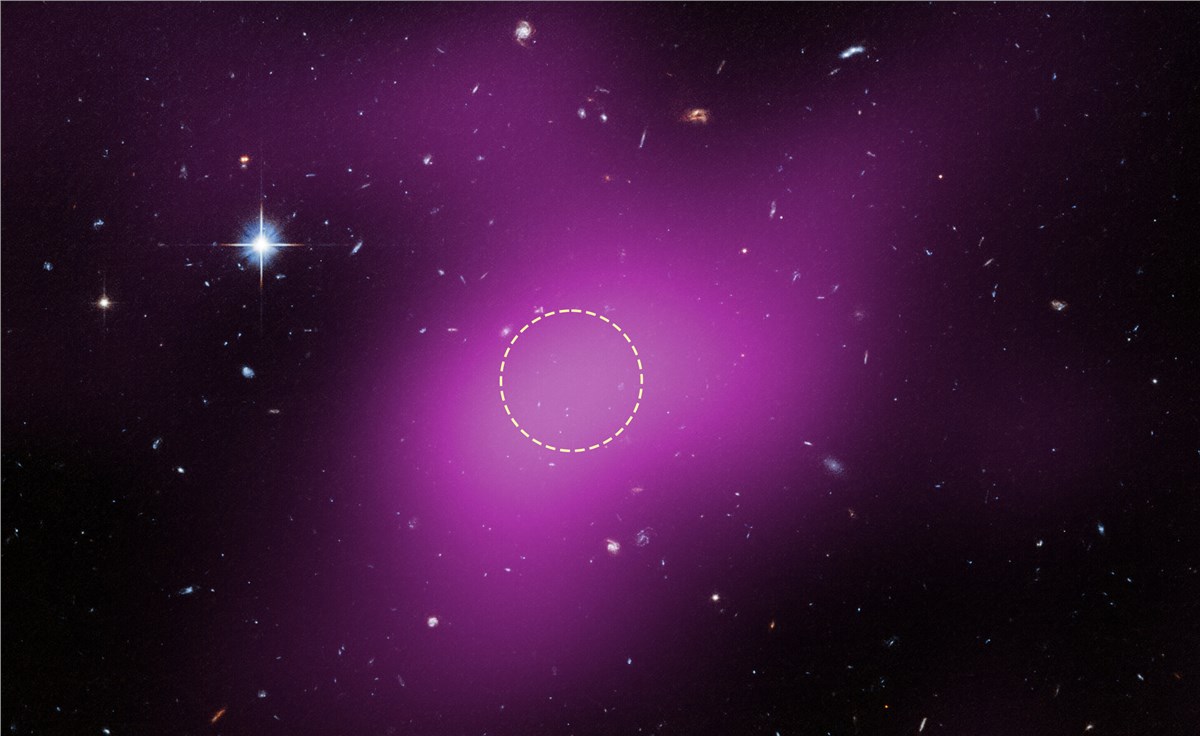
Using the NASA/ESA Hubble Space Telescope, astronomers have confirmed the existence of a long-theorized but never-before-seen astronomical object: a starless, primordial cloud dominated by dark matter. Nicknamed ‘Cloud-9,’ this object is considered a fossil remnant from the Universe’s early days, offering a rare window into the dark components of the cosmos.
“This is a tale of a failed galaxy,” said principal investigator Alejandro Benitez-Llambay. “Seeing no stars is what proves the theory right. We have found a primordial building block that hasn’t formed.” Officially termed a Reionization-Limited H I Cloud (RELHIC), Cloud-9 is composed of neutral hydrogen gas with about one million times the Sun’s mass, confined within a spherical core roughly 4,900 light-years across. Its structure, however, requires the gravitational pull of approximately 5 billion solar masses of invisible dark matter to hold it together.
The discovery confirms a key prediction about galaxy formation. Scientists theorize that in the early Universe, dark matter clumped together into halos, which then attracted gas to form stars and galaxies. Cloud-9 appears to be a dark matter halo that never accumulated enough gas to trigger star formation, remaining a dormant relic. “This cloud is a window into the dark Universe,” explained team member Andrew Fox. “It gives us a rare look at a dark-matter-dominated cloud.”
Hubble’s sensitive observations were crucial. “With Hubble’s Advanced Camera for Surveys, we’re able to nail down that there’s nothing there,” said lead author Gagandeep Anand, ruling out the possibility of faint, unseen stars. The cloud was first identified three years ago by China’s FAST radio telescope and later confirmed by other facilities. It resides near the spiral galaxy Messier 94, with slight gas distortions hinting at a possible gravitational interaction.
Cloud-9’s future remains uncertain. It may eventually acquire more gas and form stars, or it could remain in its current dormant state. Its discovery suggests many other such “failed galaxies” may be hidden nearby, outshone by brighter objects. Finding more of these dark relics will provide critical new insights into the nature of dark matter and the earliest phases of cosmic structure.
